


 PLATFORM UPDATE:


Machine learning-enabled discovery of ionic liquid–solvent electrolytes exhibiting high ionic conductivity
 a
and
Jindal K.
Shah
*a
a
and
Jindal K.
Shah
*a
Abstract
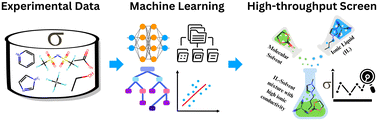
Ionic liquids (ILs), which are a class of materials with versatile nature and growing popularity, are facing impediments toward widespread usage as electrolytes due to various factors such as low ionic conductivity, high viscosity, high market price etc. One of the ways these limitations can be addressed is by mixing ILs with a molecular solvent. In a combinatorial sense, there exists an immense number of specific IL–solvent combinations. An exhaustive experimental or even simulation-based investigation of the chemical space spanned by such combinations can be extremely time-consuming, expensive, and nearly impossible. An alternative approach is to employ machine learning-based models developed from available databases. Although there exists prior literature that integrates machine learning to investigate mixtures of specific solvents with ILs, these models lack generalization necessitating development of a large number of ML models to handle various solvents. To remedy this shortcoming, as a part of designing green electrolytes with high ionic conductivity that can have potential applications in next-generation batteries and solar cells, this work aims to develop a unified machine learning model to predict ionic conductivity of any IL–solvent mixture system. In this regard, three models, namely, Random Forest, extreme gradient boosting (XGBoost), and artificial neural network (ANN) were formulated using the NIST ILThermo database. The dataset contained 549 unique ionic liquids from 16 cation families and 81 unique solvents, representing a total of 23 712 datapoints. SHAPLEY additive explanation (SHAP) method was used to assess the impact of various features on model prediction and their significance was compared with literature to gain physical insight about the model behavior. Finally, using the developed models, approximately 2.5 million IL–solvent mixtures at five different compositions were screened at room temperature. The high-throughput screening yielded nearly 19 000 IL–solvent mixtures for which ionic conductivity was found to exceed the ionic conductivity of conventional Li-ion battery electrolyte.
- This article is part of the themed collections: Foundations of Molecular Modeling and Simulation - FOMMS 2024 and MSDE Open Access Spotlight 2025
 Please wait while we load your content...


