


 PLATFORM UPDATE:


Soft material engineered synthetic polymer membranes: bridging design and application

Abstract
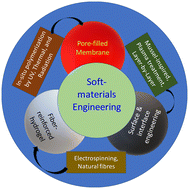
Soft material-based synthetic polymer membranes are emerging as transformative platforms for energy, environmental, and healthcare technologies, attributed to their flexibility, tunability, and multifunctionality. These membranes are designed through two principal strategies, i.e. pore-filling and surface/interface engineering. Hydrogels could also be used, especially in biomedical applications, with fibre reinforcement to enhance mechanical stability. Pore-filled or “gel-in-shell” membranes incorporate hydrogels or functional soft materials within porous polymer matrices, combining chemical functionality with structural support. These systems enable the fast and selective transport of ions or molecules, finding applications in fuel cells, batteries, solar desalination, and water purification. Stimuli-responsive designs, where thermally, chemically, piezoelectric or optically sensitive polymers are grafted within or onto membrane pores, enable dynamic control over permeability, critical for smart drug delivery and adaptive filtration. Self-healing hydrogels, driven by dynamic bonding or ionic crosslinking, further enhance membrane longevity under operational stress. On the surface engineering side, functionalization via plasma treatment, graft polymerization, layer-by-layer assembly, molecular layer deposition, or mussel-inspired polydopamine coatings enables control over surface charge, hydrophilicity, and antifouling performance. Advanced materials such as MOFs and MXenes could also be incorporated in membrane designs to enhance functional properties. These engineered interfaces, such as surface patterning or nanofiber anchoring of the surface, are crucial for addressing challenges such as fouling, poor selectivity, and biocompatibility issues typically encountered in traditional membranes. Fibre-reinforced hydrogels further expand the application scope into biomedical systems, offering tissue-like mechanical resilience for tissue scaffolds, wound dressings, and wearable biosensors. This review highlights the integrated design of soft material-based membrane systems and their application across clean energy, sustainable water technology, environmental remediation, and biomedical fields. Such multifunctional membranes are central to next-generation technologies aligned with global sustainability goals.
 Please wait while we load your content...


