


Triclosan–isatin hybrids as potent anti-proliferative agents inducing S-phase arrest via DNA gyrase inhibition in triple-negative breast cancer
 †b
Vipan
Kumar
*a
†b
Vipan
Kumar
*a
Abstract
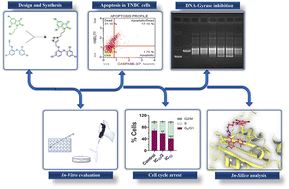
A series of 1H-1,2,3-triazole-tethered TCS–isatin hybrid compounds were synthesized and evaluated for their antiproliferative activity against triple-negative breast cancer (TNBC). These hybrids exhibited remarkable potency against MDA-MB-231 and MDA-MB-468 cell lines, with three triclosan–dibromoisatin analogues having ethyl, propyl, and butyl linkers (10m, 10n, and 10o, respectively) demonstrating particularly strong efficacy. The most potent hybrid having propyl linker (10n) outperformed standard chemotherapeutics, showing 8-, 3-, and 14-fold greater activity against MDA-MB-231 and 9-, 5-, and 13-fold greater activity against MDA-MB-468 compared to 5-fluorouracil (5-FU), cisplatin, and tamoxifen, respectively. The compounds exhibited low IC50 values (1.59–8.84 μM for MDA-MB-231; 1.14–7.56 μM for MDA-MB-468) alongside favorable selectivity indices, indicating potent anti-proliferative effects with minimal toxicity toward normal human HaCaT keratinocytes. Flow cytometric analysis revealed that compound 10n induced a dose-dependent S-phase arrest in MDA-MB-468 cells, confirming interference with DNA replication. To probe the mechanism of action, the most potent compounds 10n and 10o were assessed for E. coli DNA gyrase B inhibition. Both exhibited significant suppression of DNA supercoiling, confirming strong binding affinity to the enzyme and suggesting a potential role in topoisomerase-mediated anticancer activity.
 Please wait while we load your content...


