


 PLATFORM UPDATE:


Design and synthesis of N-3-substituted quinazolinone derivatives as anticancer agents targeting EGFR
 *a
*a
Abstract
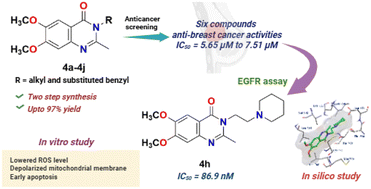
A series of new N-3-substituted quinazolinones targeting epidermal growth factor receptor (EGFR) was designed and synthesized for anticancer evaluation. All the target compounds (4a–4j) were synthesized using a two-step method with high yields and evaluated via an initial anticancer screening in lung (A549), prostate (PC-3), and breast (MCF-7) cancer cell lines. Subsequently, full dose–response (IC50) determination was performed only in the most responsive cell line, MCF-7. Compounds 4c, 4e, 4f, 4h, 4i and 4j showed promising anticancer activities against MCF-7 cells, with lower IC50 values (IC50 = 5.65 μM to 7.51 μM) than erlotinib (IC50 = 10.50 μM). The EGFR inhibitory activity of these compounds was then assessed, and 4h (IC50 = 86.9 nM) and 4i (IC50 = 154.35 nM) exhibited greater activity than erlotinib (IC50 = 197.94 nM). mRNA expression analysis reveals that MCF7 cells treated with compound 4h exhibit significantly decreased EGFR expression compared to the untreated cancer cells. In silico molecular modelling studies also indicated that the 4i–EGFR complex was less stable than the 4h–EGFR complex throughout the simulation time. Furthermore, the disruption of cellular redox homeostasis, as evidenced by reduced ROS generation, mitochondrial membrane depolarization, and the induction of apoptosis in treated cells, suggests a possible secondary anticancer mechanism.
 Please wait while we load your content...


