


 PLATFORM UPDATE:


Introducing CLipPA lipid chemodiversity to enzymatically truncated polymyxin B: a soft drug strategy to combat Gram-negative pathogens
 abc
Andrew
Siow,
abc
Jeremy G.
Owen,
f
Gavin F.
Painter,
g
Beatrix L.
Goggin,
bc
Jane R.
Allison,
bc
Scott A.
Ferguson,
ce
Paul W. R.
Harris,
*abc
Margaret A.
Brimble
*abc
and
Alan J.
Cameron
*abc
abc
Andrew
Siow,
abc
Jeremy G.
Owen,
f
Gavin F.
Painter,
g
Beatrix L.
Goggin,
bc
Jane R.
Allison,
bc
Scott A.
Ferguson,
ce
Paul W. R.
Harris,
*abc
Margaret A.
Brimble
*abc
and
Alan J.
Cameron
*abc
Abstract
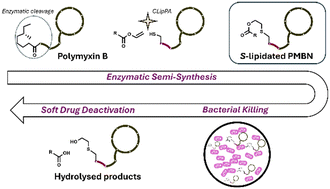
A chemodiverse library of new semi-synthetic antimicrobial peptides is reported herein. The polymyxin B nonapeptide (PMBN) holds promise as a developmental platform to access potent antimicrobial lipopeptide derivatives that circumvent the serious side effects of natural polymyxins used in clinical settings. By combining our unique radical thiol–ene lipidation strategy (CLipPA) with a chemoenzymatic synthesis, we achieved the chemoselective re-functionalisation of semi-synthetic PMBN, affording a family of potent “soft drugs” decorated with linear, cyclo- and branched alkyl and aromatic esters of varying steric properties. The high efficiency of this late-stage diversification strategy is demonstrated for lipopeptide semi-synthesis. In this process, the significance of the lipid orientation on the observed bioactivity of the molecule was determined and rationalised using molecular dynamics (MD) simulations, wherein, unlike on the parent PMB scaffold, D-Cys lipid handle was found to be superior to L-Cys in its ability to confer antimicrobial potency. The stability of linear chain and hindered ester derivatives was also evaluated in human serum, demonstrating the appropriate hydrolytic stability of a highly branched pivalate ester derivative.
- This article is part of the themed collection: Articles behind our 2026 journal covers - RSC Medicinal Chemistry
 Please wait while we load your content...


