Harnessing carlina oxide scaffold for the management of vector-borne diseases: synthesis and structure–activity relationship

Abstract

Vector-borne diseases are causes of global health concern and mosquitoes are the primary transmitters of health-threatening pathogens. Botanicals are sources of compounds structurally modifiable into versatile hits for novel plant-based insecticides. Carlina oxide (1) is a natural compound isolated from Carlina acaulis L. (Asteraceae) with promising insecticidal potential, whose industrial production is limited by the absence of a plant supply chain. Herein, a one-step synthesis producing 1 in 81% yield was developed and a structure–activity relationship (SAR) study for the larvicidal activity on Aedes albopictus (Skuse, 1894) and Anopheles stephensi (Liston, 1901) was performed. The most promising analogue (5) displayed an encouraging larvicidal action (LC50 < 6.0 μg mL−1), safety profile on human keratinocytes (IC50 > 100 μg mL−1) and non-target organisms if compared to 1. Untargeted metabolomic analysis on mosquito larvae revealed that 1 and 5 target the carbohydrates and amino acid metabolism.
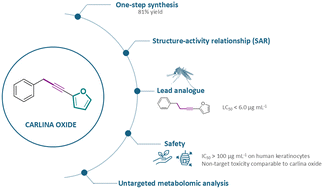
Graphical abstract: Harnessing carlina oxide scaffold for the management of vector-borne diseases: synthesis and structure–activity relationship

Supplementary files

Article information

Article type
Research Article
Submitted
19 Nov 2025
Accepted
18 Dec 2025
First published
21 Jan 2026

RSC Med. Chem., 2026, Advance Article

Harnessing carlina oxide scaffold for the management of vector-borne diseases: synthesis and structure–activity relationship

E. Spinozzi, A. Piergentili, M. Ferrati, C. Baldassarri, G. Trebaiocchi, P. Rossi, F. Araniti, A. Zambelli, L. Cappellacci, L. Zeppa, M. Giangrossi, A. Palmieri, R. Pavela, F. Maggi and R. Petrelli, RSC Med. Chem., 2026, Advance Article , DOI: 10.1039/D5MD01032B

To request permission to reproduce material from this article, please go to the Copyright Clearance Center request page.

If you are an author contributing to an RSC publication, you do not need to request permission provided correct acknowledgement is given.

If you are the author of this article, you do not need to request permission to reproduce figures and diagrams provided correct acknowledgement is given. If you want to reproduce the whole article in a third-party publication (excluding your thesis/dissertation for which permission is not required) please go to the Copyright Clearance Center request page.

Read more about how to correctly acknowledge RSC content.

Social activity

Spotlight

Advertisements