


 PLATFORM UPDATE:


Discovery of GBA-16-24 as a highly potent, selective ATR inhibitor for the treatment of FLT3-mutated acute myeloid leukemia

Abstract
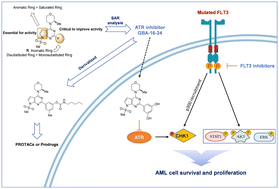
Ataxia telangiectasia mutated and RAD3-related (ATR) kinase supports cancer cell survival via managing DNA damage or replication stress in various cancers, including acute myeloid leukemia (AML). Pharmacological inhibition of ATR has emerged as a promising therapeutic strategy through synthetic lethality, particularly in contexts involving specific DNA damage response deficiencies or in combination with other agents. Herein, we report an efficient and selective ATR inhibitor, GBA-16-24, which was developed via a ring-opening strategy. Furthermore, we demonstrate its potential as a ligand for prodrugs or PROTACs. Additionally, we identify FLT3 as its potential synthetic lethal target. Compared with FLT3-wild-type acute myeloid leukemia (AML), GBA-16-24, along with other tested ATR inhibitors, more effectively inhibits cell proliferation in FLT3-mutated AML. Moreover, GBA-16-24 potently disrupts the cell cycle and induces apoptosis in MV-4-11 cells. In addition, when combined with clinically approved FLT3 inhibitors, GBA-16-24 exhibits synergistic anti-AML effects. Therefore, our findings introduce a promising ATR inhibitor and propose the combination of ATR and FLT3 inhibition as a novel synthetic lethal strategy for treating FLT3-mutated AML.
 Please wait while we load your content...


