


 PLATFORM UPDATE:


Sterically hindered catechol-derived Schiff bases: design, synthesis, SAR analysis and mechanisms of the antioxidant activity
 *ac
*ac
Abstract
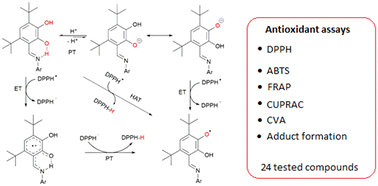
Sterically hindered phenols represent a fascinating class of redox-active compounds with unique radical regulatory properties. In this comprehensive study, we explored the in vitro antioxidant activity of 24 novel sterically hindered catechol-derived Schiff bases through a multi-technique approach. Using 2,2-diphenyl-1-picrylhydrazyl (DPPH) and 2,2′-azino-bis(3-ethylbenzothiazoline-6-sulfonic acid) diammonium salt (ABTS) radical scavenging assays alongside ferric ion reducing antioxidant power (FRAP) and copper reducing antioxidant capacity (CUPRAC) reduction potential tests, complemented by cyclic voltammetry and density functional theory (DFT) calculations with the B3LYP/UB3LYP functional and 6-311++G(d,p) basis set, we have revealed remarkable structure–activity relationships that challenge the conventional understanding of antioxidant mechanisms. Our findings suggest that antioxidant behavior is highly dependent on the structure of a Schiff base and reaction conditions, with the compound dynamically switching between hydrogen atom transfer (HAT) and electron transfer (ET) pathways. Intriguingly, thiol-derived antioxidants demonstrated exceptional activity in DPPH and ABTS assays, while their potency surprisingly decreased under acidic FRAP conditions. Electron-donating groups consistently enhanced antioxidant activity, whereas strong electron-withdrawing groups significantly compromised radical scavenging and metal reducing capacity. Mechanistic studies have revealed that Hammett constants effectively predict antioxidant behavior in the DPPH radical scavenging assay in aprotic solvents, whereas in polar media, we have observed the coexistence of HAT and single electron transfer–proton transfer (SET–PT) pathways. The ABTS assay predominantly followed the sequential proton loss electron transfer (SPLET) mechanism, while the results of FRAP and CUPRAC assays aligned best with SET–PT descriptors. Most notably, we identified the formation of ortho-quinones, disulfides, and complex adducts as key transformation products, providing unprecedented insights into the multifaceted antioxidant mechanisms of these promising compounds and opening new prospects for rational design of antioxidant agents.
 Please wait while we load your content...


