


 PLATFORM UPDATE:


Integrating green synthesis and liquid–liquid extraction of lidocaine in deep eutectic solvents
 c
and
Maria L.
Di Gioia
*a
c
and
Maria L.
Di Gioia
*a
Abstract
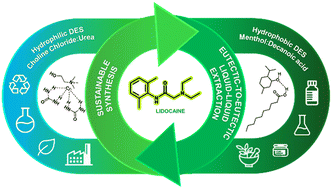
The development of greener and more sustainable processes for active pharmaceutical ingredients (APIs) remains a major challenge for the chemical industry. Here we present a fully integrated process for the synthesis of lidocaine carried out directly in a deep eutectic solvent, followed by a eutectic-to-eutectic liquid–liquid extraction into a hydrophobic DES for product recovery. The first step of the reaction affords the intermediate α-chloro-2,6-dimethylacetanilide in 92% isolated yield in 20 min; the subsequent SN2 displacement with diethylamine yields lidocaine in excellent yield under mild conditions. To further enhance process sustainability, the crude reaction mixture was subjected to a liquid–liquid extraction using a hydrophobic DES composed of menthol and decanoic acid (1 : 1 molar ratio). This innovative work-up step avoids the use of conventional organic solvents and enables direct transfer of the synthesized lidocaine into a biocompatible eutectic phase already reported for lidocaine-based formulations and delivery systems. GC-MS and FT-IR analyses confirmed exclusive partitioning of lidocaine into the hydrophobic DES. Green metrics (CHEM21) demonstrate a reduced process mass intensity (PMI) and solvent burden compared to classical routes. This study demonstrates how DESs can act simultaneously as reaction media, extractants, and formulation matrices, providing a practical blueprint for sustainable API manufacturing.
- This article is part of the themed collections: Articles behind our 2026 journal covers - RSC Medicinal Chemistry and Sustainable Medicinal Chemistry
 Please wait while we load your content...


