


 PLATFORM UPDATE:


Developing pyrazole–oxadiazole conjugates as potent anti-tubercular agents: an in silico and in vitro approach

Abstract
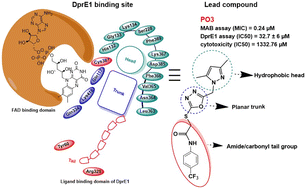
Decaprenylphosphoryl-beta-D-ribose 2′-oxidase (DprE1) is a unique enzyme in Mycobacterium tuberculosis (Mtb) essential for the synthesis of the cell wall constituent arabinan. It converts decaprenyl phosphoryl ribose (DPR) to decaprenyl phosphoryl arabinose (DPA) with DprE2. Inhibition of DprE1 affects the integrity of the cellular membrane, causing cell wall rupture, leakage of cellular contents, and ultimately, cell death. Structural analysis of the DprE1 binding site reveals three binding regions: hydrophobic head region, planar core nucleus, and solvent-accessible tail region. Based on these structural features and reported inhibitors, structure-based drug design (SBDD) was employed to design and develop 22 novel pyrazole–oxadiazole conjugates (PO1–PO22), combining a hydrophobic pyrazole and planar oxadiazole connected to an amide linker. The designed compounds were synthesized and evaluated for antitubercular activity against the Mtb H37Rv strain using the Microplate Alamar Blue (MAB) assay. Among them, PO3 and PO4 exhibited potent activity with MIC values of 0.24 and 0.53 μM, respectively, better than the known DprE1 inhibitor TCA-1 (MIC 0.66 μM). Six compounds with MICs < 2.5 μM were further screened for DprE1 inhibition. PO3 and PO4 showed IC50 values of 32.7 ± 6.0 and 39.2 ± 7.3 μM, suggesting DprE1 may not be their primary target. Molecular dynamics simulations (200 ns) supported the limited stability of DprE1–ligand complexes. Notably, the active compounds displayed excellent safety (IC50 > 500 μM) in NIH/3T3 fibroblast cytotoxicity assays. Overall, the pyrazole–oxadiazole conjugates represent promising anti-Mtb agents, likely acting through multi-target mechanisms within the pathogen.
 Please wait while we load your content...


