


 PLATFORM UPDATE:


Oxyprenyl–chalcones as antibacterial hits: design of experiments-optimized synthesis, antibacterial evaluation, early drug-like profiling and biodegradability prediction
 a
Valeria
Tudino,
a
Stefania
Butini,
a
Sacha Michèle Idriss
Cancade,
c
Jean-Denis
Docquier,
c
Federica
Perego,
d
Nicoletta
Basilico,
d
Lorenzo
Raffellini,
e
Gabriele
Carullo,
a
Sandra
Gemma
*a
and
Giuseppe
Campiani
a
a
Valeria
Tudino,
a
Stefania
Butini,
a
Sacha Michèle Idriss
Cancade,
c
Jean-Denis
Docquier,
c
Federica
Perego,
d
Nicoletta
Basilico,
d
Lorenzo
Raffellini,
e
Gabriele
Carullo,
a
Sandra
Gemma
*a
and
Giuseppe
Campiani
a
Abstract
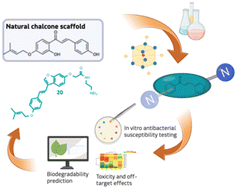
The escalating threat of antimicrobial resistance (AMR) compels the development of novel antibiotics with broad spectrum activity and environmentally responsible degradation profiles. Chalcones, naturally occurring 1,3-diaryl-2-propen-1-ones, have emerged as promising scaffolds due to their pleiotropic bioactivity and structural tunability. In this study, we explored the synthesis and functionalization of oxyprenylated chalcones as potential antibacterial compounds and explored their functionalization with protonatable moieties to enhance their affinity for bacterial membranes and their solubility properties. Starting from hydroxycordoin 1a, we synthesized a series of isomeric and hydroxy derivatives, with the aim of studying their structure–activity relationships, and based on the initial results we further modified their structure by including protonatable side chains. A key synthetic step was optimized using a design of experiments (DoE) approach, promoting resource efficiency in line with Green Chemistry principles. The antibacterial properties of the synthesized compounds were evaluated in vitro against Gram-positive and Gram-negative strains, their toxicological profiles and predicted environmental biodegradability were also assessed. These multifunctional chalcone derivatives demonstrate potential as effective and sustainable antimicrobial agents and the benzofuran derivative 20, the most potent compound of the series, could represent an interesting compound for further optmization.
- This article is part of the themed collection: Sustainable Medicinal Chemistry
 Please wait while we load your content...


