


 PLATFORM UPDATE:


Design, synthesis, and anticancer evaluation of novel pyrrole–pyrazoline/chalcone hybrids: in vitro and computational insights into EGFR inhibition

Abstract
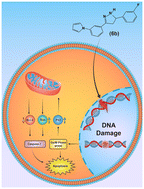
A novel series of pyrrole–pyrazoline/chalcone hybrids were designed, synthesized and evaluated for antiproliferative activity to target epidermal growth factor receptor (EGFR) inhibition. All the synthesized compounds were evaluated in the NCI panel of 59 human cancer cell lines, where compound 6b emerged as the most active analogue. Enzyme-binding assays confirmed its potent EGFR inhibitory activity (IC50 = 0.225 μM), comparable to the reference inhibitor erlotinib (IC50 = 0.198 μM). Flow cytometry analysis of human breast cancer cells (MCF-7) showed that 6b induces significant cell arrest in the G2/M phase. Real-time polymerase chain reaction (RT-PCR) experiments further confirmed the molecular mechanisms, revealing that 6b modulated key apoptotic regulators, significantly increasing the Bax/Bcl-2 ratio and upregulating p53, BAX, and caspase-7, while concurrently suppressing Bcl-2 expression. Molecular simulation studies provide evidence for the preferential binding of 6b to the active state of EGFR, consistent with the experimental results. The synthetic strategy used to prepare the pyrrole–pyrazoline/chalcone scaffold is simple, hence providing efficient access to the title compounds whose potential can be further explored as an EGFR-targeted anticancer chemotype.
 Please wait while we load your content...


