


 PLATFORM UPDATE:


Identification of spirodioxolane nsP2 helicase inhibitors with antialphaviral activity
 ab
John D.
Sears,
bc
Bose Muthu
Ramalingam,
ab
Rahman Shah Zaib
Saleem,
d
Zachary W.
Davis-Gilbert,
ab
Mohammed Anwar
Hossain,
ab
Stella R.
Moorman,
bc
Durbadal
Ohja,
bc
Sabian A.
Martinez,
be
Jane E.
Burdick,
be
Rafael M.
Couñago,
abf
Nathaniel J.
Moorman,
bc
Mark T.
Heise,
bce
Matthew H.
Todd
d
and
Timothy M.
Willson
*ab
ab
John D.
Sears,
bc
Bose Muthu
Ramalingam,
ab
Rahman Shah Zaib
Saleem,
d
Zachary W.
Davis-Gilbert,
ab
Mohammed Anwar
Hossain,
ab
Stella R.
Moorman,
bc
Durbadal
Ohja,
bc
Sabian A.
Martinez,
be
Jane E.
Burdick,
be
Rafael M.
Couñago,
abf
Nathaniel J.
Moorman,
bc
Mark T.
Heise,
bce
Matthew H.
Todd
d
and
Timothy M.
Willson
*ab
Abstract
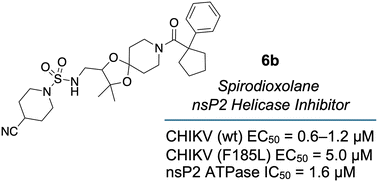
We describe the design, synthesis, and antialphaviral activity of spirodioxolane inhibitors targeting the alphavirus nsP2 helicase (nsP2hel). The spirodioxolanes are a new series of direct-acting antivirals that retain key molecular features required for inhibition of nsP2hel, including a highly substituted piperidine acetamide with its associated conformational isomerism and thermal mobility. Unlike the related oxaspiropiperidine nsP2hel inhibitors, the spirodioxolanes showed no enantioselectivity in their antiviral activity. The spirodioxolanes demonstrated antialphaviral activity against the Old World alphavirus Chikungunya virus, with some analogs also showing activity against the New World alphavirus Venezuelan equine encephalitis virus. Importantly, certain spirodioxolane analogs, such as 6b, maintained activity against viral mutants that displayed resistance to first-generation oxaspiropiperidine inhibitors, indicating their potential for optimization as a new class of broad-spectrum antialphaviral drugs.
 Please wait while we load your content...


