


 PLATFORM UPDATE:


Discovery of novel polymyxin E adjuvants against Acinetobacter baumannii guided by a stacking-based machine learning model
 *a
*a
Abstract
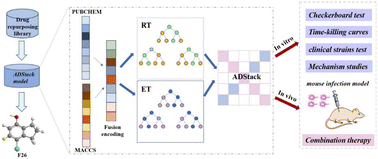
The rapid spread of antibiotic resistance poses an escalating global health crisis. Polymyxin E, the antibiotic of last resort, is limited by dose-dependent toxicity. Antibiotic adjuvants offer a promising strategy to enhance efficacy while reducing dosages, potentially mitigating this critical issue. We conducted antibiotic potentiation assays on 1245 proprietary compounds, characterized using a hybrid PubChem-MACCS molecular fingerprint approach. Following evaluation of multiple machine learning models, we developed a stacking model, ADStack, combining random forest and extreme gradient boosting algorithms. Using 0.05 as the p-value cutoff, ADStack significantly outperformed the base-classifier RF in terms of AUC on the test set. While no significant difference was observed compared to ET, ADStack achieved a slightly higher average AUC (0.808 vs. 0.797) and a lower standard deviation (0.025 vs. 0.027), indicating improved stability. This model demonstrated superior performance in identifying active molecules. We applied ADStack to screen a drug repurposing library of 9938 compounds. The top 31 candidates were acquired and tested for potentiation activity, revealing six structurally diverse compounds that enhanced the activity of polymyxin E against Acinetobacter baumannii (A. baumannii). Based on these findings, we conducted an in-depth study of compound F26. Time-kill curves demonstrated that F26, in combination with polymyxin E, effectively inhibited bacterial growth. Moreover, F26 augmented polymyxin E's bactericidal activity against various carbapenem-resistant clinical strains of A. baumannii. In a mouse model of systemic infection, the combination of F26 and polymyxin E demonstrated significant therapeutic efficacy. In silico ADMET profile evaluation demonstrated that F26 possessed good pharmacokinetic profiles and drug-likeness properties. Shapley Additive exPlanations (SHAP) analysis elucidated the relationship between molecular substructures and potentiating activity. This study demonstrated the power of machine learning in identifying novel antibiotic adjuvants, offering an innovative approach to combat antibiotic resistance.
 Please wait while we load your content...


