


 PLATFORM UPDATE:


Design, synthesis and structure–activity relationship analysis of dibenzodiazepinone derivatives against Osimertinib resistant NSCLC
 *a
and
Yan-Long
Ma
*a
*a
and
Yan-Long
Ma
*a
Abstract
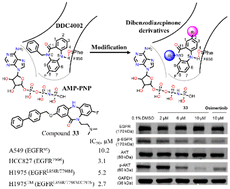
Lung cancer, particularly NSCLC, is the leading cause of cancer-related deaths worldwide, accounting for over 80% of cases. Mutations in the epidermal growth factor receptor (EGFR) are key drivers of NSCLC. Although three generations of EGFR tyrosine kinase inhibitors (TKIs) have been developed, resistance limits their efficacy. The dibenzodiazepinone scaffold exhibits diverse biological activities, however, reports on its derivatives for treating NSCLC with EGFR mutations, particularly triple mutations, are rare. Guided by the binding model of DDC4002 with EGFRT790M/V948R, this study synthesized and characterized 36 dibenzodiazepinone analogues, evaluating their antiproliferative activity against NSCLC cell lines. Structure–activity relationship analysis highlighted the importance of substituents at the C2 and N10 positions. Compound 33 exhibited the strongest inhibitory effects, especially for H1975™ cells (EGFRL858R/T790M/C797S) with a 2.4-fold lower IC50 (2.7 μM) than osimertinib (6.5 μM). It effectively inhibited colony formation, migration of H1975™ cells, induced G0/G1 arrest, and promoted apoptosis through suppressing EGFR and AKT phosphorylation. These findings demonstrate the potential of optimizing the dibenzodiazepinone framework for developing novel potent molecules against osimertinib resistant NSCLC cells, providing valuable insights for future research.
 Please wait while we load your content...


