


 PLATFORM UPDATE:


Evaluating the FEP+ protocol for predicting binding affinity of congeneric ligands towards various soluble proteins

Abstract
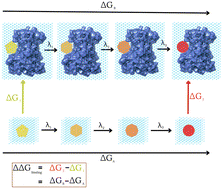
Generating libraries of congeneric series of compounds and development of structure–activity relationships (SAR) is a common practice among medicinal chemists. While various computational methods are available to guide scaffold optimization, their reliability in prediction can vary. Ligand free energy perturbation (FEP+) is a rigorous computational program that computes the relative binding free energies between two congeneric ligands against a target, thereby identifying the ligand with greater binding affinity. In this study, we evaluated the FEP+ method to predict the relative binding affinity of two ligands from a congeneric series towards the target proteins. A total of 34 ligand transformations were performed, spanning across 21 soluble proteins. Relative binding free energies were calculated and compared with the experimental value to assess the accuracy of prediction. With a mean unsigned error of 0.46 kcal mol−1 and coefficient of determination, R2 = 0.85, the results of this work suggest that the FEP+ is a reliable tool for the medicinal chemist to predict the relative free energies of binding with good statistical significance, demonstrating its utility in SAR development in drug discovery.
 Please wait while we load your content...


