


 PLATFORM UPDATE:


Indentation of glasses that produce a boundary-forming annular crack
 *a
J.
Wu,
a
*a
J.
Wu,
a
Abstract
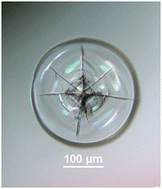
A series of boroaluminosilicate glasses are designed to span the range of Vickers indentation cracking behaviors. At one endpoint, median/radial cracking is observed, whereas the other endpoint exhibits ring and cone cracking. In the transition in cracking behavior across the glass series, a composition space is identified that produces a large boundary-forming annular crack that prevents the extension of radial cracks emanating from the indent impression. Indentation cross-sectioning shows that this unique cracking system forms as a traditional cone crack, which is then redirected back to the surface following unloading by residual stress. The percentage of volume displaced from 30 mN Berkovich scratch grooves was 10–15% for glasses that produce the annular crack. This places this new glass space on the anomalous end of the deformation continuum, but with more volume-conserving shear component than fully anomalous glass like silica. This unique combination of densification and shear enables the formation of the initial cone crack (densification contribution) and provides the residual stress (shear contribution) that causes the cone crack to be redirected back to the surface. Retardance measurements through the cross-section show that residual stresses initially associated with lateral crack extension interact with the cone crack to drive it back to the surface.
 Please wait while we load your content...


