


 PLATFORM UPDATE:


Additive manufacturing of biodegradable metals for medical implants: current progress, key challenges, and future perspectives
 *e
*e
Abstract
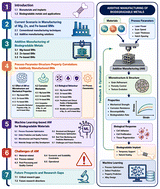
The additive manufacturing process (AM) plays a vital role in the medical field, such as manufacturing surgical tools, models, implants, and medical equipment, owing to its capability to fabricate customized and intricate shape parts. Although considerable development is shown in the research area of the AM processes compared to traditional methods for the fabrication of metal-based degradable biomaterials, viz., iron (Fe), magnesium (Mg), and zinc (Zn), it is still at an early stage. It may be noted that while Zn has a medium degradation rate and strong biocompatibility, the AM is difficult due to porosity issues and element loss. These complications are primarily due to evaporation under a high-energy electron beam during melting. While Mg is biocompatible and possesses sufficient mechanical properties comparable to human bone, its nature is explosive and corrosive. Fe has good mechanical properties and the highest strength relative to Mg and Zn; its degradation rate is poor. Thus, all these biodegradable materials have unique benefits and drawbacks, making the bioimplant manufacturing methodology for each substance distinctive. This work has conducted an extensive review of the mechanical, corrosion behaviour, and biological properties of different degradable biomaterials using different AM techniques. The effect of AM techniques on different materials and their final product properties has been studied in this review. The characteristics of the final product depend on the materials, design, processing, and application that make biodegradable metals (BMs) a typical subject that covers various fields of study, such as biomaterials, engineering, and medicine.
- This article is part of the themed collection: Recent Review Articles
 Please wait while we load your content...


