


 PLATFORM UPDATE:


The influence of tethered dopant templates on the electrochemical, nanomorphological, and nanomechanical properties of 2D conductive polymer films
 abc
Rosanne M.
Guijt,
e
Paul R.
Stoddart,
f
Simon E.
Moulton,
fghi
Saimon
M. Silva
abc
and
George W.
Greene
*abc
abc
Rosanne M.
Guijt,
e
Paul R.
Stoddart,
f
Simon E.
Moulton,
fghi
Saimon
M. Silva
abc
and
George W.
Greene
*abc
Abstract
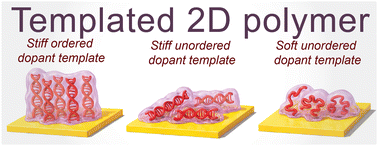
Chemical electropolymerization can reliably produce two-dimensional (2D) and ultrathin conductive polymer films but offers limited control over nanomorphology and mechanical stiffness. To address this limitation, we investigate the use of DNA as a tethered dopant template, where the fixed charges of anionic DNA macromolecules grafted onto an electrode are used to dope and finely control electropolymerization in deionized water. The grafted layer adopts distinct conformations and stiffness depending on whether it is single- or double-stranded. Because the chemical composition of the dopant remains unaltered, variations in the resulting conductive polymer films arise solely from differences in the physical properties of the dopant layer. Our findings show that the nanomorphology of the polymer film directly reflects the morphology of the template, and that the dopant enhances mechanical stiffness with minimal impact on electrochemical performance. These results demonstrate that tethered dopant templating is a versatile platform for controlling the conductivity and electrochemical performance of molecularly engineered 2D polymer films, while dopant selection provides a powerful means for manipulating morphological and mechanical properties.
 Please wait while we load your content...


