


 PLATFORM UPDATE:


Unlocking the potential of a novel 2D VBC and a VBC/graphene heterostructure as efficient hosts for Li-ion batteries
 b
and
Chong-Wen
Zhou
*a
b
and
Chong-Wen
Zhou
*a
Abstract
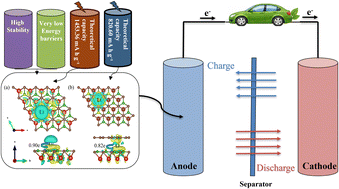
In this work, we employ first-principles calculations to predict the potential of a two-dimensional (2D) vanadium borocarbide (VBC) monolayer and a VBC/graphene heterostructure as promising anode materials for lithium-ion batteries (LIBs). This work introduces ternary 2D VBC and VBC/graphene heterostructures as a novel class of materials, integrating boron to provide mechanical robustness and carbon to ensure high electrical conductivity. This unique composition yields a synergistic combination of record-high capacity, metallic conductivity, and negligible volume expansion due to the graphene layer. The VBC monolayer and the VBC/graphene heterostructure are thermodynamically, mechanically, and dynamically stable, confirming their feasibility for experimental realization. Notably, the metallic nature of both systems is advantageous for facilitating rapid electronic transport during battery cycling. Remarkably, the VBC monolayer and the VBC/graphene heterostructure exhibit ultrahigh theoretical specific capacities of 1453.36 mAh g−1 and 820.60 mAh g−1, respectively, which significantly surpass those of conventional graphite anodes. Furthermore, the low average open-circuit voltages of 0.45 V for the VBC monolayer and 0.68 V for the heterostructure ensure energy efficiency, while the low Li-ion diffusion barriers of 0.22 eV and 0.31 eV, respectively, indicate excellent ionic mobility and rapid charge–discharge kinetics. Lattice variation during maximum lithiation is small (2.57% for the VBC monolayer and 2.88% for the VBC/graphene heterostructure), confirming the robustness of the frameworks against volume expansion. Bader analysis shows strong charge transfer from Li to the VBC host, validating strong electrochemical interactions and a reversible lithiation process. These outstanding characteristics establish the VBC monolayer and the VBC/graphene heterostructure as highly promising candidates for next-generation high-performance LIBs.
 Please wait while we load your content...


