


 PLATFORM UPDATE:


Design and fabrication of a polyaniline-grafted nanocarbon material for energy harvesting applications
 †ae
Thanh Huy
Nguyen,
†ae
Bui Anh Duy
Nguyen,
ae
Ngoc Phuong Thuy
Tran,
ae
Thi My Linh
Phan,
ae
Huu An
Ho,
ae
Tri Hieu
Pham,
ae
Quoc Phu
Phan
*ae
†ae
Thanh Huy
Nguyen,
†ae
Bui Anh Duy
Nguyen,
ae
Ngoc Phuong Thuy
Tran,
ae
Thi My Linh
Phan,
ae
Huu An
Ho,
ae
Tri Hieu
Pham,
ae
Quoc Phu
Phan
*ae
Abstract
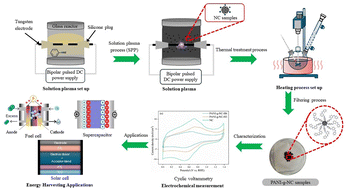
Recently, the development of high-performance, low-cost materials with tunable redox properties has been of interest for advancing sustainable energy devices. In this study, nanocarbon (NC) particles derived from aniline and polyaniline-grafted nanocarbons (PANI-g-NC) were synthesized via a combination of solution plasma processing and a thermal reflux system. Compared with traditional catalysts, these PANI-g-NC hybrids offer distinct advantages: they avoid the high expense and limited availability of noble metals, provide higher electrical conductivity than pristine polymers, and introduce redox-active nitrogen functionalities that conventional carbons often lack. The solution plasma method enables the direct formation of nitrogen-doped nanocarbons from liquid aniline without the use of external templates. At the same time, the thermal reflux step ensures the efficient grafting of polyaniline chains onto the carbon surface. The obtained samples were characterized using advanced techniques, including SEM, TEM, Raman spectroscopy, XRD, and cyclic voltammetry (CV). SEM and TEM images revealed that the nanocarbon particles exhibit a spherical morphology. The FTIR spectra showed characteristic peaks corresponding to N–H stretching, aromatic C![[double bond, length as m-dash]](https://www.rsc.org/images/entities/char_e001.gif) C stretching, and C–N stretching in amines, confirming the successful grafting of polyaniline onto the nanocarbon surface. XRD analysis identified distinct diffraction peaks associated with multiple crystalline phases: nanocarbons (C), tungsten oxide (WO3), and metallic tungsten (W). Meanwhile, electrochemical measurements (cyclic voltammetry) indicated a gradual decrease in the cyclic voltammetry loop area with increasing PANI grafting time. This study demonstrates an effective strategy to integrate the high electrical conductivity of nanocarbons with the redox activity of polyaniline via solution plasma processing, providing a green, sustainable, and low-cost platform for exploring charge-transfer mechanisms. More importantly, the PANI-g-NC hybrids exhibit a distinctive electrochemical behavior compared to conventional nanocarbons or bare polyaniline. The synergistic combination of a conductive carbon backbone with redox-active nitrogen functionalities in PANI enables a hybrid charge-storage mechanism that simultaneously enhances electron transport, proton accessibility, and catalytic site density. This dual contribution underlines the novelty of the present material design and its promising potential as an efficient and durable electrocatalyst.
C stretching, and C–N stretching in amines, confirming the successful grafting of polyaniline onto the nanocarbon surface. XRD analysis identified distinct diffraction peaks associated with multiple crystalline phases: nanocarbons (C), tungsten oxide (WO3), and metallic tungsten (W). Meanwhile, electrochemical measurements (cyclic voltammetry) indicated a gradual decrease in the cyclic voltammetry loop area with increasing PANI grafting time. This study demonstrates an effective strategy to integrate the high electrical conductivity of nanocarbons with the redox activity of polyaniline via solution plasma processing, providing a green, sustainable, and low-cost platform for exploring charge-transfer mechanisms. More importantly, the PANI-g-NC hybrids exhibit a distinctive electrochemical behavior compared to conventional nanocarbons or bare polyaniline. The synergistic combination of a conductive carbon backbone with redox-active nitrogen functionalities in PANI enables a hybrid charge-storage mechanism that simultaneously enhances electron transport, proton accessibility, and catalytic site density. This dual contribution underlines the novelty of the present material design and its promising potential as an efficient and durable electrocatalyst.
 Please wait while we load your content...


