How well do conventional atomistic simulations predict adsorption binding sites in metal–organic frameworks compared to experiment?

Abstract

Classical force fields are widely used for simulating adsorption in MOFs, and limitations for global properties such as uptakes are known. For the first time, experimental binding sites across diverse MOFs and adsorbates were compared against simulated results to demonstrate that classical force fields reliably reproduce binding site locations even when adsorption isotherms disagree. Errors arising from experimental uncertainty and approximations of routine classical simulations such as flexibility and chemisorption are evaluated.
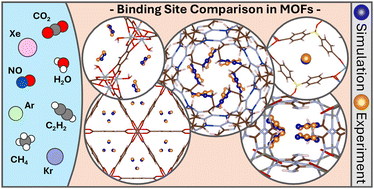
Graphical abstract: How well do conventional atomistic simulations predict adsorption binding sites in metal–organic frameworks compared to experiment?

Supplementary files

Article information

Article type
Communication
Submitted
09 Feb 2026
Accepted
18 Mar 2026
First published
24 Mar 2026
This article is Open Access
Creative Commons BY license

Mater. Adv., 2026, Advance Article

How well do conventional atomistic simulations predict adsorption binding sites in metal–organic frameworks compared to experiment?

J. Burner, O. Marchand, S. Warshawsky, M. Gibaldi and T. K. Woo, Mater. Adv., 2026, Advance Article , DOI: 10.1039/D6MA00185H

This article is licensed under a Creative Commons Attribution 3.0 Unported Licence. You can use material from this article in other publications without requesting further permissions from the RSC, provided that the correct acknowledgement is given.

Read more about how to correctly acknowledge RSC content.

Social activity

Spotlight

Advertisements