Recent advances in membranized coacervates as functional compartments: synthetic strategies and mechanisms for prototissues

Abstract

Compartmentalization, a defining feature of living cells, has inspired the engineering of functional microcompartments that organize reactions and transport in cell-mimetic ways. Among current strategies, bottom-up approaches have attracted particular attention because they assemble synthetic compartments from nonliving building blocks such as polymers, peptides, and lipids. Herein, we review recent advances in complex coacervates as versatile platforms for protocells, with an emphasis on multiphase organization, key physicochemical properties, and structure–function relationships that govern assembly, stability, and regulated exchange. We further highlight major formation and functionalization routes, boundary reinforcement (membranes or membrane-like shells), stimulus-triggered droplet-to-vesicle transitions, and hierarchical assembly into prototissues, which enable controlled encapsulation, intercompartmental communication, and collective functions, such as distributed catalysis and homeostatic regulation. Finally, we discuss biomedical opportunities of coacervate-based compartments and outline future directions toward robust, programmable, and life-like artificial systems that sharpen design rules at the interface of synthetic constructs and living matter.
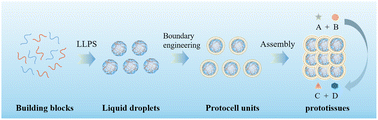
Graphical abstract: Recent advances in membranized coacervates as functional compartments: synthetic strategies and mechanisms for prototissues

Transparent peer review

To support increased transparency, we offer authors the option to publish the peer review history alongside their article.

View this article’s peer review history

Article information

Article type
Review Article
Submitted
03 Feb 2026
Accepted
13 Mar 2026
First published
08 Apr 2026
This article is Open Access
Creative Commons BY-NC license

Mater. Adv., 2026, Advance Article

Recent advances in membranized coacervates as functional compartments: synthetic strategies and mechanisms for prototissues

Y. Lv, X. Wang, J. Yang, X. Chen and M. Abbas, Mater. Adv., 2026, Advance Article , DOI: 10.1039/D6MA00159A

This article is licensed under a Creative Commons Attribution-NonCommercial 3.0 Unported Licence. You can use material from this article in other publications, without requesting further permission from the RSC, provided that the correct acknowledgement is given and it is not used for commercial purposes.

To request permission to reproduce material from this article in a commercial publication, please go to the Copyright Clearance Center request page.

If you are an author contributing to an RSC publication, you do not need to request permission provided correct acknowledgement is given.

If you are the author of this article, you do not need to request permission to reproduce figures and diagrams provided correct acknowledgement is given. If you want to reproduce the whole article in a third-party commercial publication (excluding your thesis/dissertation for which permission is not required) please go to the Copyright Clearance Center request page.

Read more about how to correctly acknowledge RSC content.

Social activity

Spotlight

Advertisements