


 PLATFORM UPDATE:


Copper immobilized on a layered magnetite-based nanocatalyst for sustainable Ullmann cross-coupling reaction
 *a
*a
Abstract
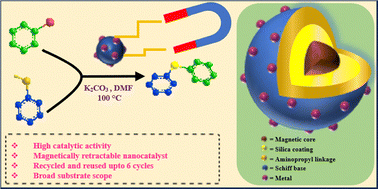
This study demonstrates the efficient synthesis of diarylthioethers via C–S cross-coupling between diverse aryl halides and arylthiols utilizing a magnetically retractable Fe3O4@SiO2–PrNH2–SA–Cu(II) nanocatalyst using K2CO3 as a base in DMF. The heterogeneous nanocatalyst was fabricated through a multistep process. The designed catalyst was characterized using various techniques, such as XRD, HRTEM, FESEM, STEM, EDAX, elemental mapping, TGA, VSM, XPS, ICP-OES and FT-IR. The catalyst design provides a dual role of the Schiff base-anchoring copper ions, to accelerate the oxidative addition and reductive elimination steps. This method makes use of ligand-free synthesis of diarylsulfides, enabling magnetic recovery and reuse of the catalyst for up to 6 cycles. The nanocatalyst exhibited high catalytic activity and a broad substrate scope. The magnetic nature of the nanocatalyst enabled easy separation from the reaction mixture using an external magnet, thus simplifying the workup. The synthesized nanocatalyst was then utilized for the synthesis of diarylthioethers and heterodiarylthioethers. The pure compounds were characterized using 1H and 13C NMR. This catalytic system offers a cost-effective, efficient, and simple protocol for the formation of the C–S bond.
 Please wait while we load your content...


