


 PLATFORM UPDATE:


Graphene-assisted porosity in acrylate-endcapped urethane-based hydrogels for biomedical applications
 *ab
Nicolas
Deroose,
c
Beatriz
García-Béjar,
d
María
Arévalo-Villena,
d
Sonia
Merino,
ab
Ester
Vázquez,
ab
M. Antonia
Herrero
*ab
and
Peter
Dubruel
*c
*ab
Nicolas
Deroose,
c
Beatriz
García-Béjar,
d
María
Arévalo-Villena,
d
Sonia
Merino,
ab
Ester
Vázquez,
ab
M. Antonia
Herrero
*ab
and
Peter
Dubruel
*c
Abstract
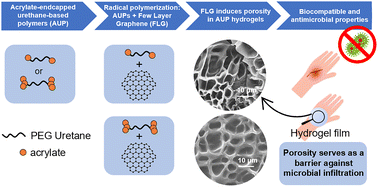
The development of advanced hybrid hydrogels is essential for biomedical applications, such as tissue engineering, drug delivery, and wound healing. The incorporation of additives, such as graphene, imparts specific functional properties to hydrogel networks. In this work, we report the successful integration of few-layer graphene (FLG) into acrylate-endcapped urethane (AUP) hydrogels, resulting in hybrid materials with enhanced structural and functional properties. Notably, the introducton of FLG induces the formation of a porous microstructure within an otherwise non-porous AUP network, representing a simple and effective strategy to generate porosity without the use of porogens or templating methods. This induced porosity is critical for promoting nutrient diffusion and cellular infiltration. In addition to this structural modification, FLG contributes to the reinforcement of hydrogels and influences the crystallization behavior, acting as a nucleating agent, highlighting its role as an active component in the hydrogel matrix rather than a passive filler. A comprehensive characterization, including mechanical, thermal, and morphological analyses, was conducted to elucidate the role of FLG within the hydrogel matrix. The resulting materials exhibit high gel fractions, tunable swelling behavior, and mechanical properties within the range relevant for soft tissue applications. In vitro cytotoxicity assays confirmed the biocompatibility of the FLG-enhanced hydrogels, validating their safety for potential biomedical applications. Antimicrobial assessment demonstrated a limited, concentration-dependent inhibition of bacterial growth, primarily at higher FLG contents. Overall, this study demonstrates a straightforward approach to engineer porous AUP-based hydrogels through FLG incorporation, expanding their potential for biomedical applications.
 Please wait while we load your content...


