


 PLATFORM UPDATE:


Ligand specific bioconjugation induced modulation of quantum yield in CdTe and graphene quantum dots
 *b
and
Gurpal
Singh
*a
*b
and
Gurpal
Singh
*a
Abstract
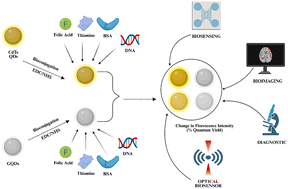
Quantum yield (QY) is essential for assessing the efficacy of fluorescent nanomaterials, especially for biosensing, bioimaging, and optoelectronic applications. It indicates the efficacy with which a material emits light when excited, and this efficacy directly influences our ability to detect and visualize biological activities at the molecular scale. The present study evaluated how bioconjugation of biologically relevant compounds to quantum dots (QDs) can influence their QY. We used cadmium telluride (CdTe) QDs capped with mercaptopropionic acid and nitrogen-doped graphene QDs (GQDs) as model systems. These were combined with folic acid, thiamine, cobalamin, bovine serum albumin, and DNA via EDC/NHS coupling chemistry. Our results indicated that QY is significantly influenced by the type of biomolecule and its concentration. While CdTe Qds exhibited superior intrinsic QY, GQDs displayed enhanced stability and biocompatibility, with certain conjugations significantly increasing their fluorescence. These findings underscore the significance of surface chemistry in modulating the optical properties of QDs. The present research thoroughly examines changes in QY during conjugation, providing essential insights for the development of advanced nanoprobes that are both fluorescent and stable, as well as biologically responsive. The research establishes a basis for developing modified, high-efficiency fluorescence systems for diagnostic, sensing, and therapeutic purposes.
 Please wait while we load your content...


