


 PLATFORM UPDATE:


Tailoring the properties of (TiZrHfV)B2 high-entropy diborides via elemental concentration tuning: a first-principles approach

Abstract
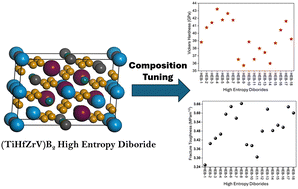
High entropy diboride (HEB) ceramics are prospective materials for thermal protection systems and high temperature structural materials due to their excellent heat resistance, high temperature stability, super hardness, and wear resistance. The efficacy of high entropy ceramics lies in their tailorable properties and compositional flexibility. The present study uses first principles methods to design tailor made Ti, Zr, Hf, and V based HEBs with enhanced structural, mechanical, and thermal stability by tuning the stoichiometry of constituent metals. The thermodynamic phase and structural stability of 18 HEB compositions with varied elemental stoichiometry was confirmed using ΔHmix, ΔGmix, and enthalpy–entropy parameters and band-filling theory. A Vickers hardness of 35.72–43.22 GPa suggests the super-hardness of studied HEBs. Higher fractions of Ti in HEBs (Ti0.42Zr0.17Hf0.25V0.17B2 and Ti0.42Zr0.25Hf0.25V0.08B2) favored enhanced hardness while Hf rich Ti0.08Zr0.25Hf0.42V0.25B2 showed the highest fracture toughness of 3.65 MPa m1/2. Almost all non-equiatomic compositions displayed higher melting points (3480–3934 K) and Ti0.33Zr0.25Hf0.25V0.17B2 exhibited the highest melting point of 3934 K. The highest Young's (539 GPa), shear (238 GPa), and bulk (246 GPa) moduli exhibited by the HEB having the highest Ti and lowest V concentrations (Ti0.42Zr0.25Hf0.25V0.08B2) indicate remarkable elastic rigidity and superior resistance to shape and volume deformation. The findings accentuate the compositional flexibility of HEBs and highlight the importance of stoichiometry tailoring to develop HEBs with enhanced mechanical, thermodynamic, and structural stability. The present study emphasizes the effectiveness and superior properties of non-equiatomic compositions compared to the widely explored equiatomic compositions.
 Please wait while we load your content...


