


 PLATFORM UPDATE:


Self-healable bio-based solid polymer electrolytes incorporating ionic liquids for safer lithium–ion batteries
 a
Sravendra
Rana
*a
a
Sravendra
Rana
*a
Abstract
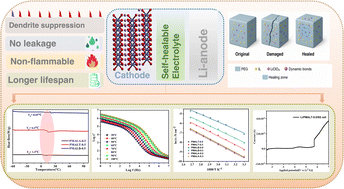
Self-healable polymeric electrolytes are crucial for ensuring the durability, safety and sustainability of lithium–ion batteries. Herein, we report advances in the design of bio-derived, self-healable solid polymer electrolytes that overcome three well-entrenched limitations – good self-healing behaviour, limited ionic mobility, and a narrow electrochemical window. Using a blend polymeric composition of polyethylene glycol (PEG) and bio-based methyl cellulose (MC) consisting of a dynamic disulfide moiety (covalent adaptive network) and imidazolium-based ionic liquids (EMIM-TFSI, EMIM-Br, and EMIM-Ac), we present a variety of self-healable polymer electrolytes. Synergistic improvements in sustainability, flexibility, ion mobility and potential window by adding different ionic liquids were studied and demonstrated by physicochemical and electrochemical characterization, including FTIR, XRD, DSC, TGA, stress–strain analysis, SEM, ionic conductivity, dielectric study, electrochemical stability window (ESW), and lithium transference number. The prepared self-healable electrolytes possess good ionic conductivity (10−3 S cm−1) at higher temperature, a good permittivity value with respect to frequency, a wide electrochemical stability window (>5.5 V), and exceptional scratch-healing efficiency (due to reversible disulfide exchange networks). The integrated self-healing mechanism and superior electrochemical properties validate the potential of the developed self-healable polymer electrolytes as robust candidates for durable solid-state lithium–ion batteries.
 Please wait while we load your content...


