


 PLATFORM UPDATE:


Synthesis and morphology control of SbSeI thin films at elevated pressure
 *ab
Ivan
Caño,
ab
David
Rovira,
ab
Alex
Jimenez-Arguijo,
ab
Gabriel
Aygur,
c
Joaquim
Puigdollers,
ab
Edgardo
Saucedo
ab
*ab
Ivan
Caño,
ab
David
Rovira,
ab
Alex
Jimenez-Arguijo,
ab
Gabriel
Aygur,
c
Joaquim
Puigdollers,
ab
Edgardo
Saucedo
ab
Abstract
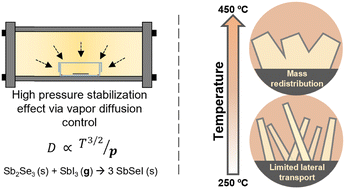
SbSeI is a promising quasi-one-dimensional chalcohalide for optoelectronic applications, but its strong tendency to form needle-like structures makes thin-film morphology difficult to control. Here, we investigate the temperature- and time-dependent evolution of SbSeI formed by the reaction of Sb2Se3 thin films with SbI3 vapour under elevated pressure. Systematic SEM, XRD, and cross-sectional EDS analyses reveal two distinct growth regimes. At low temperature, incomplete conversion and limited lateral mass transport yield dense, thin needles and thickness distributions that evolve towards Weibull-like behaviour. At higher temperatures, conversion occurs largely during the heating ramp, resulting in the formation of a continuous SbSeI-rich underlayer, and subsequent mass redistribution promotes thicker needles with lognormal thickness statistics. These results support a two-interface growth mechanism in which the accessibility of iodine-rich species and thermally activated surface mass transport together govern the transition from thin to thick needles. These findings provide practical guidelines for tuning the temperature, time, and pressure to engineer the morphology of SbSeI films and offer a mechanistic framework that may be transferable to other quasi-one-dimensional chalcohalides governed by anisotropic growth.
 Please wait while we load your content...


