


 PLATFORM UPDATE:


Self-assembly, wet adhesion, and mineralization of Balcp20k-P3 derived from Balanus albicostatus cement
 a
a
Abstract
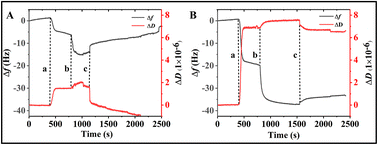
Based on the previously screened functional derivative peptide Balcp20k-P3 (hereafter referred to as P3), this study systematically elucidates its environmentally responsive mechanisms and biomedical functions through multi-scale characterization techniques. Transmission electron microscopy (TEM) and Fourier-transform infrared spectroscopy (FT-IR) analyses revealed that under conditions mimicking the barnacle's physiological microenvironment (pH 5.0, ionic strength: 150 mM NaCl), P3 self-assembled into discrete short rod-like fibers (100–200 nm in length) with a β-sheet content of only 16.57%. In contrast, under seawater-like conditions (pH 8.0, ionic strength: 600 mM NaCl), P3 reorganized into continuous three-dimensional network structures (fiber diameter: 100 nm, length > 1 µm), accompanied by a significant increase in β-sheet content to 35.76%. Quantification via quartz crystal microbalance with dissipation (QCM-D) demonstrated that the wet adhesion strength of P3 under seawater conditions was 11.7-fold higher than that under physiological conditions (p < 0.001), with exceptional shear-resistant stability (only 7% mass loss post-rinsing). Furthermore, considering the inherent biomineralization function of cp20k, the mineralization efficacy of P3 under conditions of pure water, seawater, and a simulated barnacle physiological environment was characterized using scanning electron microscopy (SEM), energy-dispersive spectroscopy (EDS), and X-ray diffraction (XRD). The results indicated that P3 effectively induces the mineralization of calcium carbonate to form crystalline structures with different morphological characteristics, and the morphological features of these mineralized products showed a certain correlation with their self-assembled structures. This study is the first to systematically demonstrate that the derived peptide P3 of the barnacle adhesive protein cp20k can undergo dynamic self-assembly driven by changes in environmental ionic strength/pH and efficiently induce calcium carbonate mineralization. The results suggest that cp20k may utilize the differences in ionic strength and pH between its internal environment and seawater to regulate its underwater wet adhesion properties in situ and promote the formation of a calcareous chassis. These findings not only deepen the understanding of the molecular mechanisms of barnacle adhesive proteins but also provide a strategy for designing novel biomimetic underwater adhesives.
 Please wait while we load your content...


