


 PLATFORM UPDATE:


Harnessing the untapped potential of a lanthanide-based perovskite (RbYbCl3) absorber: from material properties to device implementation

Abstract
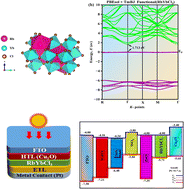
The increasing demand for clean and sustainable energy has led to intensified research into lead-free perovskite materials as potential alternatives for next-generation photovoltaic devices. This study investigates the highly promising lanthanide-based perovskite RbYbCl3 as a stable and efficient absorber using a multiscale approach that combines first-principles analysis with device-level simulations. Structural optimization through Birch–Murnaghan equation of state (EOS) fitting confirmed the thermodynamic stability of the cubic perovskite phase (Pm![[3 with combining macron]](https://www.rsc.org/images/entities/char_0033_0304.gif) m). Additionally, electronic structure calculations revealed a direct band gap that falls within the optimal range for solar energy harvesting. The direct band gaps calculated using both the PBEsol and TB-mBJ methods were found to be 0.343 eV and 1.713 eV, respectively. Optical analysis indicated a strong absorption coefficient (∼105 cm−1), low reflectivity, and minimal energy loss across the visible and ultraviolet spectrum, highlighting the material's suitability for photovoltaic applications. To translate these intrinsic properties into practical applications, SCAPS-1D simulations were conducted using tailored transport layers. Among 64 combinations, we tested devices with IGZO, SnS2, WO3, and ZnO as electron transport layers (ETLs) and Cu2O as the hole transport layer (HTL) in the configuration FTO/ETL/RbYbCl3/Cu2O/Pt. The highest achieved power conversion efficiency was 25.06%, with an open-circuit voltage of 1.328 V, a short-circuit current of 22.85 mA cm−2, and a fill factor of 89.36% at an absorber thickness of ≥1.0 µm, which matches almost 95% of the Shockley–Queisser limit for solar cells. This study demonstrates a strong correlation between material-level properties and device-level outcomes, establishing RbYbCl3 as a promising lanthanide-based, lead-free perovskite absorber. The findings not only expand the scope of rare-earth halide perovskites in photovoltaics but also pave the way for their future integration into scalable and stable solar energy technologies.
m). Additionally, electronic structure calculations revealed a direct band gap that falls within the optimal range for solar energy harvesting. The direct band gaps calculated using both the PBEsol and TB-mBJ methods were found to be 0.343 eV and 1.713 eV, respectively. Optical analysis indicated a strong absorption coefficient (∼105 cm−1), low reflectivity, and minimal energy loss across the visible and ultraviolet spectrum, highlighting the material's suitability for photovoltaic applications. To translate these intrinsic properties into practical applications, SCAPS-1D simulations were conducted using tailored transport layers. Among 64 combinations, we tested devices with IGZO, SnS2, WO3, and ZnO as electron transport layers (ETLs) and Cu2O as the hole transport layer (HTL) in the configuration FTO/ETL/RbYbCl3/Cu2O/Pt. The highest achieved power conversion efficiency was 25.06%, with an open-circuit voltage of 1.328 V, a short-circuit current of 22.85 mA cm−2, and a fill factor of 89.36% at an absorber thickness of ≥1.0 µm, which matches almost 95% of the Shockley–Queisser limit for solar cells. This study demonstrates a strong correlation between material-level properties and device-level outcomes, establishing RbYbCl3 as a promising lanthanide-based, lead-free perovskite absorber. The findings not only expand the scope of rare-earth halide perovskites in photovoltaics but also pave the way for their future integration into scalable and stable solar energy technologies.
 Please wait while we load your content...


