


 PLATFORM UPDATE:


Transition metal-embedded Nb2S2C as a high-performance bifunctional electrocatalyst for the OER and ORR: insights from DFT simulations

Abstract
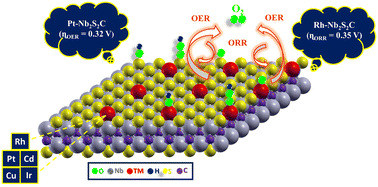
The commercialization of energy storage and conversion technologies depends on the development of effective electrocatalysts. In this study, we investigate the incorporation of transition metal (TM) dopants – platinum (Pt), copper (Cu), iridium (Ir), cadmium (Cd), and rhodium (Rh) into two-dimensional Nb2S2C to enhance electrocatalytic performance for the oxygen evolution reaction (OER) and oxygen reduction reaction (ORR). Density Functional Theory (DFT) calculations reveal that TM-doped Nb2S2C substantially lowers the overpotentials, achieving 0.32 V for the OER with Pt–Nb2S2C and 0.35 V for the ORR with Rh–Nb2S2C. Partial density of states (PDOS) analyses indicate that the TM dopant modulates the electronic structure of Nb2S2C, facilitating the adsorption and activation of reaction intermediates and thus improving catalytic efficiency. The OOH dissociation step is identified as the rate-determining step in the four-electron ORR pathway for Rh–Nb2S2C, with an activation energy of 2.25 eV. Furthermore, ab initio molecular dynamics (AIMD) simulations confirm the structural and thermodynamic stability of Pt- and Rh-doped Nb2S2C under operational conditions. These findings offer a rational strategy for designing high-performance Nb2S2C-based electrocatalysts and underscore the potential of Pt- and Rh-doped systems as stable and efficient catalysts for the OER and ORR in sustainable energy technologies.
 Please wait while we load your content...


