


 PLATFORM UPDATE:

Smartphone-assisted urinary methylmalonic acid sensing using an imidazole-based probe via the analyte-triggered aggregation mechanism

Abstract
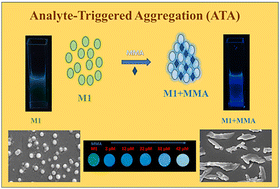
Methylmalonic acid (MMA) is a key biomarker for vitamin B12 deficiency, and its sensing via a turn-on-based fluorescence mechanism is less explored. The maximum efficiency reported corresponds to only a few-fold increase in the emission. Similarly, the mechanism by which the emission turns on remains unaccounted for. Here, we report an imidazole-based non-fluorescent probe, M1, which turns on blue fluorescence upon the addition of MMA due to the ‘analyte-triggered aggregation’ (ATA) mechanism. An aggregation of probe molecules is triggered by MMA, which is mediated by hydrogen bonding and electrostatic interactions between the probe molecules. The probe-analyte interactions and aggregation formation were corroborated by 1H NMR, FTIR, DLS, FESEM, zeta potential measurements, and density functional theory (DFT). The analyte triggered a fluorescence enhancement of the probe of 73-fold (the best reported yet), with an observed detection limit of 5.78 µM. M1 demonstrated excellent selectivity toward MMA over biological interfering elements commonly found in human urine. The scope of M1 in practical applications was validated by detecting MMA in real urine samples, achieving recovery rates of 95–108%. This work presents a detailed sensing mechanism with a cost-effective, non-invasive, and field-deployable strategy (smartphone) for monitoring vitamin B12 deficiency viaMMA detection.
 Please wait while we load your content...


