Controlled sulfidation of silver: a pathway to Ag2S for short-term synaptic emulation

Abstract

Neuromorphic computing demands scalable, energy-efficient synaptic devices, yet conventional synthesis routes impose prohibitive cost and complexity barriers. This work presents a transformative strategy for material design in which room-temperature exposure to hydrogen sulfide gas converts thermally deposited silver films into phase-pure monoclinic α-Ag2S, a superionic conductor well-suited for electrochemical metallization (ECM) switching. Structural characterization confirms complete FCC-to-monoclinic phase transformation within 48 hours. Planar Ag/Ag2S/Ag memristors fabricated from these films exhibit robust unipolar resistive switching with exceptional reproducibility across 16 devices. Systematic pulse-train studies reveal consistent short-term plasticity (STP) behavior, with volatile retention averaging ∼49 seconds at 100 µA compliance. This synthesis approach eliminates vacuum processing requirements, enabling the scalable production of high-performance α-Ag2S switching layers. This positions ECM devices as accessible and practical elements for neuromorphic hardware.
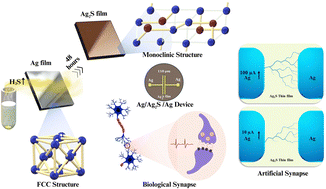
Graphical abstract: Controlled sulfidation of silver: a pathway to Ag2S for short-term synaptic emulation

Supplementary files

Article information

Article type
Communication
Submitted
11 Dec 2025
Accepted
05 Jan 2026
First published
20 Jan 2026
This article is Open Access
Creative Commons BY-NC license

Mater. Adv., 2026, Advance Article

Controlled sulfidation of silver: a pathway to Ag2S for short-term synaptic emulation

S. Bhat, N. Bannur, N. T. Kizhakkeveettil, R. Pujar and G. S. Chandrasekhar, Mater. Adv., 2026, Advance Article , DOI: 10.1039/D5MA01446H

This article is licensed under a Creative Commons Attribution-NonCommercial 3.0 Unported Licence. You can use material from this article in other publications, without requesting further permission from the RSC, provided that the correct acknowledgement is given and it is not used for commercial purposes.

To request permission to reproduce material from this article in a commercial publication, please go to the Copyright Clearance Center request page.

If you are an author contributing to an RSC publication, you do not need to request permission provided correct acknowledgement is given.

If you are the author of this article, you do not need to request permission to reproduce figures and diagrams provided correct acknowledgement is given. If you want to reproduce the whole article in a third-party commercial publication (excluding your thesis/dissertation for which permission is not required) please go to the Copyright Clearance Center request page.

Read more about how to correctly acknowledge RSC content.

Social activity

Spotlight

Advertisements