


Gamma irradiation-induced structural and defect modulation in β-TeO2 thin films at different annealing temperatures

Abstract
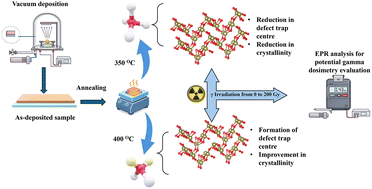
TeO2 thin films were deposited on glass substrates using thermal vacuum deposition with optimized deposition parameters. The deposited films were subsequently exposed to gamma irradiation at doses ranging from 0 to 200 Gy and systematically characterized to evaluate the dose-dependent changes in structural, optical, and electrical properties. A notable temperature-dependent response was observed after thermal annealing. The samples annealed at 350 °C exhibited progressive crystallinity degradation with increasing gamma dose, whereas the samples annealed at 400 °C demonstrated enhanced crystallinity. X-ray photoelectron spectroscopy (XPS) and field emission scanning electron microscopy (FESEM) analyses revealed significant oxygen depletion in the 400 °C annealed samples following gamma irradiation. Raman spectroscopy revealed a pronounced shift in the characteristic peak for the 400 °C annealed films irradiated at 200 Gy; conversely, the Raman peak was entirely absent in the 350 °C annealed sample at the same irradiation dose, corroborating the XRD observations. The optical band gap exhibited an inverse relationship with increasing gamma dose. Photoluminescence measurements indicated reduced emission intensity at higher doses, attributed to enhanced non-radiative recombination pathways. The modulation of the EPR signal intensity observed before and after gamma irradiation demonstrates that the concentration of paramagnetic defects varies systematically with radiation dose, highlighting TeO2 thin films as promising candidates for precision EPR gamma dosimetry and real-time radiation sensing applications. Electrical characterization demonstrated a dose-dependent increase in the concentration of paramagnetic defects at 200 Gy, which acted as trap centres. The study establishes annealing temperature as a critical controlling parameter governing radiation–matter interactions in TeO2 thin films. It directly correlates oxygen depletion and paramagnetic defect evolution with dose-dependent changes in structural, optical, and electrical properties. Furthermore, the investigation reveals TeO2 thin films as tunable EPR-based gamma dosimeters, wherein defect concentration and signal intensity can be precisely engineered through controlled annealing and irradiation dose for high-precision radiation sensing applications.
 Please wait while we load your content...


