


 PLATFORM UPDATE:


Investigating the impact of non-ideal conditions on the performance of an RbGeI3 perovskite solar cell through a combination of SCAPS-1D, machine learning and deep learning approaches

Abstract
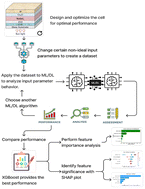
In this work, the SCAPS-1D simulator is used to design and analyze an RbGeI3-based perovskite solar cell (PSC) with the structure FTO/ZnO/RbGeI3/Cu2O/Ni. The proposed structure is evaluated under ideal and experimentally motivated non-ideal conditions. Initially, significant parameters such as thickness, bandgap, and doping concentration corresponding to different layers are optimized under ideal conditions, and a maximum efficiency of 30.41% is achieved. However, when non-ideal parameters such as the realistic values of defect density at bulk and interfaces, parasitic resistances, reflection loss, and radiative and Auger recombination losses are introduced, the efficiency of the cell decreases from 30.41% to 19.68%. Although the performance of the proposed device declines substantially, it reflects real-life conditions for the lead-free RbGeI3-based PSC. Additionally, to identify the most accurate algorithm in PSC design technology, seven machine learning and four deep learning algorithms are compared in this study. Among them, XGBoost provides optimum accuracy with an excellent R2 value of 0.9999 and a lower MSE of 0.0038. Furthermore, the influence of individual non-ideal parameters on the efficiency of the proposed structure is investigated, and it is found that shunt resistance dominates the efficiency among the five features. Therefore, this theoretical study will help to minimize trial-and-error efforts in designing pragmatically efficient RbGeI3-based PSCs.
 Please wait while we load your content...


