


 PLATFORM UPDATE:


Confinement-driven equilibrium shifts in steam methane reforming: a monte carlo study in zeolites

Abstract
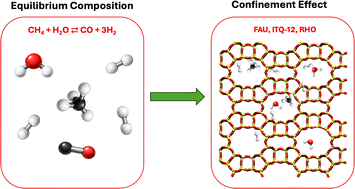
Steam methane reforming (SMR) remains the dominant industrial route for hydrogen production, yet its highly endothermic nature demands elevated temperatures, resulting in substantial energy input and CO2 emissions. In this work, we investigate whether thermodynamic confinement within nanoporous materials can alter the confined-phase composition under SMR-relevant conditions and evaluate the potential equilibrium shift in coupled reaction-separation systems towards enhanced hydrogen production at lower temperatures. Using reaction ensemble Monte Carlo and grand Canonical Monte Carlo simulations, we validate our molecular models against experimental bulk-phase data, and then systematically compare confinement-induced composition changes in large- and small-pore zeolites. Our results reveal that large-pore zeolite FAU, in both hydrophilic (NaX) and hydrophobic (pure silica) forms, fails to outperform the bulk. In contrast, the small-pore zeolite ITQ-12 shows hydrogen enrichment in the confined phase. At 1 bar and 675 °C, ITQ-12 achieves hydrogen mole fractions comparable to those in the bulk at 825 °C, representing an apparent 150 °C reduction in temperature with potential for considerable energy savings. Zeolite RHO, despite similar pore size, shows no such improvement, highlighting the critical role of channel geometry and topological confinement. These findings demonstrate that properly selected zeolite topologies can thermodynamically steer SMR towards more sustainable conditions. The framework established here offers a predictive route to identify nanoporous materials capable of enabling low-temperature hydrogen production.
 Please wait while we load your content...


