


 PLATFORM UPDATE:


Comparison of properties and performance of Eu2+-doped Ca6BaP4O17, Ca4Sr(PO4)3Cl, NaSrPO4 and Sr3Al2O5Cl2 thermometric phosphors

Abstract
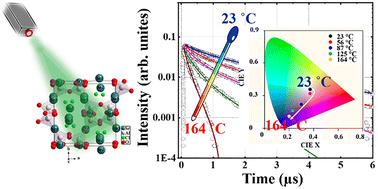
The temperature sensitivity of a luminescent material depends on its thermodynamic properties, such as its activation energy (ΔE). In this work, we demonstrated the dependence of the relative temperature sensitivity (Sr) on ΔE for four thermometric phosphors, namely Ca6BaP4O17:0.05Eu2+ (CBP:Eu), Ca4Sr(PO4)3Cl:0.02Eu2+ (CSPC:Eu), NaSrPO4:0.04Eu2+ (NSP:Eu) and Sr3Al2O5Cl2:0.1Eu2+ (SAC:Eu), for which the values of ΔE varied according to SAC:Eu > CBP:Eu > NSP:Eu > CSPC:Eu. The maximum values of Sr behave in a correlated manner, with values of 1.973, 1.452, 0.610 and 0.137% °C−1, respectively. At room temperature, the phosphors possessed good Sr values of 1.148% °C−1 (SAC:Eu), 0.349% °C−1 (CBP:Eu), 0.346% °C−1 (NSP:Eu) and 0.089% °C−1 (CSPC:Eu), indicating their potential for thermometry applications at near ambient temperatures. This demonstrates that to increase the sensitivity, the value of ΔE should be maximized. The energy gap between the 5d excited state of Eu2+ ions and the conduction band minimum, the thermal ionization energy (ΔEi), showed an irregular relationship with ΔE, likely because ΔE was obtained from data measured at elevated temperatures, whereas the other was obtained from room temperature data. Considering the obtained values of ΔE and ΔEi, thermal ionization is the dominant mechanism for thermal quenching in CSPC:Eu, NSP:Eu and SAC:Eu, whereas the rate for both thermal ionization and non-radiative crossover relaxation mechanisms is similar in CBP:Eu. The values of the quantum yield for SAC:Eu, NSP:Eu, CBP:Eu, and CSPC:Eu are 35, 23, 19, and 10%, respectively. Factoring in all the obtained values, SAC:Eu demonstrates the best performance among all the phosphors.
 Please wait while we load your content...


