


 PLATFORM UPDATE:


Electrochemical cement synthesis: a materials-centered framework for reactor design, manufacturing, and technoeconomic feasibility
 a
and
Nageh K.
Allam
*a
a
and
Nageh K.
Allam
*a
Abstract
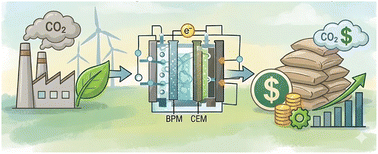
The cement industry accounts for approximately 8% of global CO2 emissions, representing one of the most challenging sectors for decarbonization. Electrochemical approaches to cement synthesis offer a transformative pathway to eliminate process emissions while enabling the utilization of renewable electricity. This comprehensive review critically examines the design principles, operational challenges, and technological advances in electrochemical reactors for cement production. Reactor configurations ranging from three-compartment systems employing bipolar and cation exchange membranes to innovative zero-gap designs, which achieved voltages as low as 0.38 V at 100 mA cm−2, have been analyzed. Key technical challenges including membrane fouling, electrode degradation, and scaling considerations are systematically evaluated alongside emerging solutions such as orthogonalized ion management and composite membrane technologies. Performance metrics demonstrate Faradaic efficiencies approaching 100% with Ca(OH)2 production rates of 486 mg h−1, while techno-economic analyses reveal pathways to cost competitiveness under favorable electricity pricing and carbon policy scenarios. The review identifies critical research priorities including advanced membrane materials, process intensification strategies, and integrated system optimization as essential for commercial deployment. This work provides a foundational framework for understanding the current state and prospects of electrochemical cement synthesis technologies.
- This article is part of the themed collection: Recent Review Articles
 Please wait while we load your content...


