


 PLATFORM UPDATE:


DFT-driven insights into the electronic, magnetic, and transport properties of a 2D Nb3C2 MXene for high-performance Li-ion batteries
 *a
and
*a
and
Abstract
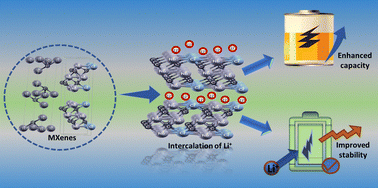
‘MXenes’, two-dimensional materials, have attained significant attention for their outstanding characteristics inherent to their nanostructures. However, to date, the Nb3C2 MXene, particularly in Cr-doped form, has not been theoretically explored for Li-ion battery applications. In this work, first-principles calculations were performed to explore the structural, electronic, magnetic, and transport properties of newly designed pristine Nb3C2 and Cr-doped Nb3C2, along with their energy storage potential, using the FP-LAPW approach. Both structures are dynamically and thermally stable, as confirmed from phonon dispersion and AIMD simulations. Electronic properties, including the band structure and density of states, indicate metallic behavior in both structures with an indirect band gap, fulfilling a key requirement for electrode materials in energy storage systems. Pristine Nb3C2 exhibits an essentially non-magnetic ground state, while Cr-doped Nb3C2 exhibits ferromagnetic behavior. Theoretical capacities of 169 mAh g−1 for pristine Nb3C2 and 280 mAh g−1 for Cr-doped Nb3C2 were obtained, indicating a substantial enhancement upon Cr doping and exceeding that of pristine Nb2C (170 mAh g−1) reported in the literature. The predicted electrochemical properties unveil that both pristine and Cr-doped Nb3C2 possess favorable open-circuit voltages within the desirable range for anode materials, along with high electronic conductivity and improved gravimetric capacity. Furthermore, transport property analysis based on semi-classical Boltzmann theory highlights their promising thermoelectric behavior, complementing their electrochemical performance and providing a comprehensive evaluation of MXenes in energy storage devices.
- This article is part of the themed collection: Solution-processed Perovskites and 2D Materials for Energy, Optoelectronics, and Computation Devices
 Please wait while we load your content...


