Auxetic polypropylene foams as high mechanical performance materials

Abstract

This study focuses on converting polypropylene (PP) foams into auxetic metamaterials using vacuum and mechanical compression (VMC). The PP foams (initial density of 45 kg m−3) underwent treatments involving heat, vacuum and mechanical pressure to create a re-entrant cellular structure essential to generate a negative Poisson's ratio (NPR). The resulting foams exhibit significantly enhanced stiffness, making them suitable for applications in sports and military protection. The effect of vacuum and mechanical compression are optimized to achieve the best auxetic properties. The treated foams are characterized for density, porosity, open cell content (OCC), cell morphology, Poisson's ratio (ν) and mechanical properties. The optimized auxetic foams have high density (100–133 kg m−3) and show NPR under both tensile (−0.23) and compressive (−0.08) deformation. More importantly, the toughness is improved by up to 438% compared to the original foam with a 200% increase of the elastic limit. Furthermore, the compression stress is improved by 416% at 50% compressive strain. Finally, thermo-mechanical data show that auxetic PP foams have improved properties as temperature increases.
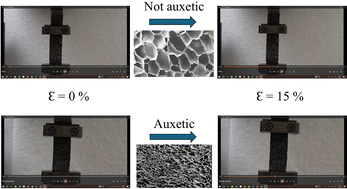
Graphical abstract: Auxetic polypropylene foams as high mechanical performance materials

Supplementary files

Article information

Article type
Paper
Submitted
14 Nov 2025
Accepted
23 Jan 2026
First published
30 Mar 2026
This article is Open Access
Creative Commons BY-NC license

Mater. Adv., 2026, Advance Article

Auxetic polypropylene foams as high mechanical performance materials

X. Y. Chen and D. Rodrigue, Mater. Adv., 2026, Advance Article , DOI: 10.1039/D5MA01329A

This article is licensed under a Creative Commons Attribution-NonCommercial 3.0 Unported Licence. You can use material from this article in other publications, without requesting further permission from the RSC, provided that the correct acknowledgement is given and it is not used for commercial purposes.

To request permission to reproduce material from this article in a commercial publication, please go to the Copyright Clearance Center request page.

If you are an author contributing to an RSC publication, you do not need to request permission provided correct acknowledgement is given.

If you are the author of this article, you do not need to request permission to reproduce figures and diagrams provided correct acknowledgement is given. If you want to reproduce the whole article in a third-party commercial publication (excluding your thesis/dissertation for which permission is not required) please go to the Copyright Clearance Center request page.

Read more about how to correctly acknowledge RSC content.

Social activity

Spotlight

Advertisements