


 PLATFORM UPDATE:


Multiscale prediction of polymer relaxation dynamics via computational and data-driven methods
 †b
and
Anh D.
Phan
†*ab
†b
and
Anh D.
Phan
†*ab
Abstract
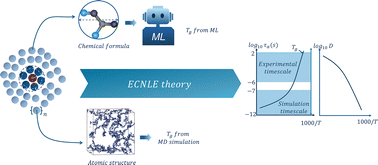
We present a multiscale modeling approach that integrates molecular dynamics simulations, machine learning, and the elastically collective nonlinear Langevin equation (ECNLE) theory to investigate the glass transition dynamics of polymer systems. The glass transition temperatures (Tg) of four representative polymers are estimated using simulations and a machine learning model trained on experimental datasets. These predicted Tg values are used as inputs to the ECNLE theory to compute the temperature dependence of structural relaxation times and diffusion coefficients, and the dynamic fragility. The Tg values predicted from simulations show good quantitative agreement with experimental data. While machine learning tends to slightly overestimate Tg, the resulting dynamic fragility values remain close to experimental fragilities. Overall, ECNLE calculations using these inputs agree well with broadband dielectric spectroscopy results. Our integrated approach provides a practical and scalable tool for predicting the dynamic behavior of polymers, particularly in systems where experimental data are limited.
- This article is part of the themed collection: Popular Advances
 Please wait while we load your content...


