


 PLATFORM UPDATE:


High thermoelectric power conversion efficiency of an earth-abundant Janus silicon oxy-sulfide monolayer: a first-principles study

Abstract
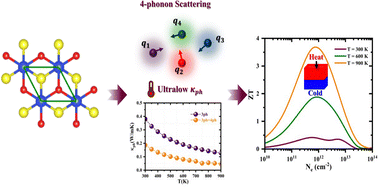
The tunable properties of Janus monolayers, along with advances in their synthesis, make these low-symmetry materials excellent candidates for thermoelectric power generation. In this study, we systematically investigate the electronic and thermal properties of the Janus silicon oxy-sulfide monolayer. The results based on density functional theory reveal that the monolayer is stable. It exhibits a tunable direct band gap and strong covalent bonding. Its ultralow lattice thermal conductivity (<0.38 W mK−1 at 300 K) is attributed to the broken phonon selection rule for phonon–phonon scattering and a high level of anharmonicity, as reflected in the large Grüneisen parameter. Furthermore, the inclusion of four-phonon scattering introduces additional anharmonic phonon–phonon interactions, leading to a 50% reduction in lattice thermal conductivity, which results in a significant enhancement of the thermoelectric figure of merit of 3.62 and power conversion efficiency of 30.89% for the n-type Janus SiOS monolayer, highlighting its potential for efficient waste heat recovery applications.
 Please wait while we load your content...


