


 PLATFORM UPDATE:


Visible light-driven photocatalytic properties of polyphosphodiester-protected silver nanocomposites

Abstract
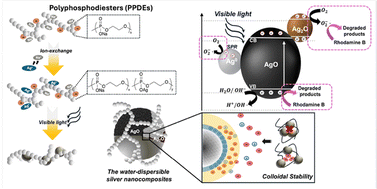
Silver nanocomposites are used to develop photocatalysts for various environmental, energy, and biomedical applications. However, the stability, biocompatibility, and performance of these colloids for practical applications need further improvement. Herein, silver nanocomposites protected with polyphosphodiesters (PPDEs) were successfully synthesized. A conjugate was prepared by varying the ratio of phosphodiesters to silver acetate, which were then exposed to visible light to form the silver nanocomposites, known as PEP·NaaAgb-l (a and b correspond to the ratio of Na+ and Ag+ in the feed). Then, the stability, photocatalytic activity, and recyclability of the colloids were evaluated. The spectral changes observed before and after irradiation confirmed the formation of photogenerated nanocomposites. The morphology of PEP·NaaAgb-l was characterized by transmission electron microscopy (TEM), high-resolution transmission electron microscopy (HRTEM), selected area electron diffraction (SAED), and X-ray photoelectron spectroscopy (XPS). The silver nanocomposites efficiently degraded rhodamine B (RhB) under visible light, with the degradation efficiency of PEP·Na5Ag1-l reaching 89% (k = 5.12 × 10⁻² min−1), indicating their photocatalytic performance. These nanocomposites achieved over 87% degradation of RhB even after six cycles, demonstrating their recyclability. The stability and recyclability of the colloids were reinforced by the polyphosphodiester. The role of specific reactive oxygen species (ROS) was explored by the conventional scavenger approach. The silver nanocomposites play a crucial role in the heterojunction, enhancing not only light harvesting but also increasing the capacity for electron acceptance and suppressing electron–hole recombination.
 Please wait while we load your content...


