


 PLATFORM UPDATE:


Investigation of the adsorption nature of the hydroxyurea anti-cancer drug with pristine and transition metal (Co,Fe,Ni)-doped boron nitride fullerenes as a potential drug-delivery vehicle: a DFT study and COSMO analysis

Abstract
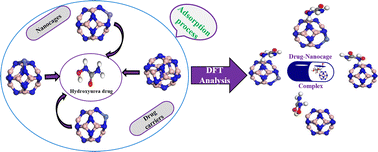
Finding an appropriate drug delivery vehicle for anti-cancer drugs is crucial to minimizing the adverse effects of chemotherapy and enhancing treatment efficacy. Among various approaches, nanostructure-based drug delivery systems have attracted significant attention. In this context, boron nitride (B12N12) nanocages have emerged as promising candidates for targeted drug delivery. In the present study, the adsorption behavior, reactivity, and electronic sensitivity of the hydroxyurea (HU) drug on B12N12, CoB11N12, FeB11N12, and NiB11N12 nanocages were investigated in both gas and aqueous media using first-principles density functional theory (DFT) calculations. Our findings indicate that all complexes are thermodynamically stable. The stability of these complexes in both media is confirmed by the increased negative adsorption energy (EAD) and negative solvation energy of the doped nanocages. Among them, the HU/NiB11N12 complex exhibits the highest stability, with EAD values of −1.00 eV (gas) and −0.86 eV (aqueous). Its stability is further supported by the enhanced dipole moment, increasing from 7.36 D to 11.40 D upon adsorption. Moreover, after adsorption, the HOMO–LUMO energy gap of the HU/NiB11N12 complex decreases significantly by ∼53.86% (gas) and ∼53.70% (aqueous), indicating substantial changes in its electronic properties. These results suggest that doped nanocages exhibit high sensitivity, making them excellent candidates for drug delivery applications. Quantum molecular descriptors further confirm that NiB11N12 offers higher sensitivity and reactivity compared to the other nanocages studied. Therefore, the HU/NiB11N12 complex stands out as the most promising drug delivery system, with NiB11N12 identified as the most effective nanocage carrier for the HU drug.
 Please wait while we load your content...


