


 PLATFORM UPDATE:

Nano-assembly and cytotoxicity of the l-valine–polyamine conjugates of betulinic acid
 b
Zdeněk
Wimmer
*a
b
Zdeněk
Wimmer
*a
Abstract
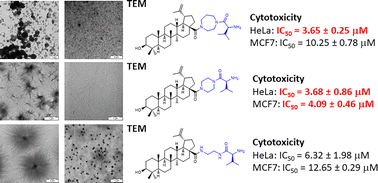
Six target derivatives of betulinic acid with several L-valine–polyamine conjugates were synthesized as a part of a series of 15 new compounds. The structures of all target compounds and their intermediates were elucidated by standard analytical methods. The target compounds were subjected to transmission electron microscopy (TEM) to prove their ability to form nano-assemblies in methanol and in water and to cytotoxicity assays in two cancer cell lines, cervical cancer (HeLa) and breast adenocarcinoma (MCF7), using normal human fibroblasts (BJ) as reference cells for determining the cytotoxicity of the investigated compounds. For detailed TEM studies, the target compounds (6, 7, 11, 12, 16 and 17) were dissolved in methanol and in water, and their nano-assemblies were observed after the application of the microscale fast-solvent removal protocol. All compounds were found to form various combinations of three basic morphologies: (i) isometric nanoparticles with the size ranging from 10 to 100 nm, (ii) long nanofibres with a thickness below 10 nm, and (iii) thin amorphous films upon fast-solvent removal. The fibrous morphologies were often located around the isometric nanoparticles and tended to grow with time. The nano-assemblies formed in methanol were often different from those formed in water, but the above-mentioned three basic morphologies (nanoparticles, nanofibres, and thin amorphous films) could be observed reproducibly for each compound. The target compounds showed cytotoxicity in the cancer cell lines, and regrettably, in non-malignant cells as well. Compounds 12 and 17 displayed the highest cytotoxicity against the HeLa cancer cell line among the synthesized compounds. Compound 12 also showed the highest cytotoxicity against the MCF7 cancer cell line. The effect of a dynamic self-assembly process on cytotoxicity was investigated in all target compounds. All of the studied compounds showed a better cytotoxicity profile against the HeLa cancer cell line than cisplatin, a pharmacologically used anticancer agent. This effect was less pronounced in the MCF7 cancer cell line and in normal human fibroblasts.
 Please wait while we load your content...


