


 PLATFORM UPDATE:


Exploring synergistic effects of a neodymium-based metal organic framework with SWCNTs and MXene for hybrid energy storage devices

Abstract
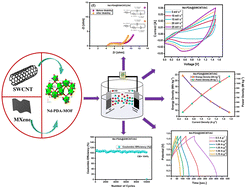
Hybrid supercapacitors (HSCs) with high energy density and power density, along with an extended cycle life, have emerged as ultimate energy storage devices. Owing to their high redox activity, large surface area, porous topological framework, open topological structure, and configurable morphology, metal–organic frameworks (MOFs) have attracted substantial interest as electrode materials. However, they suffer from the problems of poor electrical conductivity and inadequate stability. Herein, a neodymium-based MOF derived from pyridine-2,6-dicarboxylic acid (Nd-PDA) and its composites with an MXene (Nd-PDA@MXene) and single-walled carbon nanotubes (Nd-PDA@SWCNT) were developed, and their applicability as electrode materials was analyzed through electrochemical characterizations. The electrochemical analysis displayed that the Nd-PDA@SWCNT composite exhibited superior electrochemical performance with an outstanding specific capacity (Qs) of 260.91 C g−1 and specific capacitance (Cs) of 521.82 F g−1 at a current density of 1 A g−1. The Nd-PDA@SWCNT composite was integrated with activated carbon (AC) to design an HSC, which demonstrated a Qs of 104.24 C g−1 and a Cs of 69.49 F g−1 (555.92 mF cm−2) at 0.5 A g−1. A maximum specific energy (Es) of 21.71 Wh kg−1 and specific power (Ps) of 1151 W kg−1 with a Coulombic efficiency (CE) of 99% were determined even after 10 000 charging–discharging cycles. Dunn's method was employed to assess the capacitive and diffusive contributions. The findings indicate that the Nd-PDA@SWCNT composite is an outstanding electrode material for application in hybrid energy-storage devices.
 Please wait while we load your content...


