


 PLATFORM UPDATE:


Optimization of lead-free BiFeO3 perovskite solar cells for efficient solar-energy conversion in futuristic green technologies
 *a
and
Shahid
Atiq
*a
*a
and
Shahid
Atiq
*a
Abstract
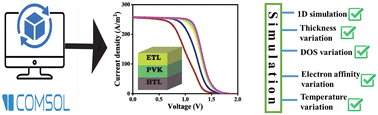
The adverse effects of global warming and our dependence on hazardous energy sources, like coal and petroleum, have shifted focus toward solar energy, a sustainable and clean solution. Perovskite materials, particularly BiFeO3, are attracting attention as absorber layers due to their multifunctional properties. This study employs COMSOL to simulate 1D TiO2/BiFeO3/Spiro-OMeTAD solar cells with ideal ohmic contacts at different operating temperatures. Results demonstrate that the short-circuit current density increases with the BiFeO3 thickness, and efficiency peaks at an optimal thickness. However, the maximum efficiency of 10.88% is achieved (in TiO2/BiFeO3/Spiro-OMeTAD) when the electron-transport layer's density of states in the valence and conduction bands (NCNV) is ∼2 × 1016 cm−3, while TiO2/SnS/BiFeO3/Spiro-OMeTAD shows the maximum efficiency of 20.99% at the SnS layer thickness of 700 nm. Moreover, an increase in BiFeO3's bandgap enhances the open-circuit voltage (Voc) but reduces the fill factor. On the other hand, BiFeO3's NCNV has no significant impact on efficiency but shows inverse coupling with Voc. Additionally, increasing BiFeO3's electron affinity improves the fill factor, while increasing TiO2's and Spiro's electron affinities enhances the Voc and power output, respectively. This work provides insights for optimizing material properties and device parameters in experimental applications and highlights the potential of BiFeO3-based perovskites for next-generation photovoltaics.
 Please wait while we load your content...


