


 PLATFORM UPDATE:


Low temperature green synthesis of red emitting Pb-free CsMnBr3 perovskite films
 *a
Fuqian
Yang
a
*a
Fuqian
Yang
a
Abstract
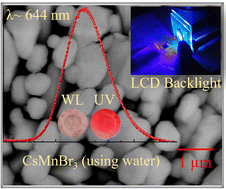
Lead halide perovskites (APbX3) have demonstrated exceptional opto-electronic properties, but their inherent toxicity and environmental hazards hindered their practical deployment in display technologies such as liquid crystal display (LCD) backlights. Herein, we report for the first time a facile, water-mediated synthesis of red-emitting CsMnBr3 thin films from an aqueous solution of CsBr and MnBr2 precursors at a low temperature of ∼50 °C. Unlike traditional synthesis routes reported for synthesis of CsMnBr3 powders or nanocrystals, relying heavily on toxic solvents, high temperatures, or inert atmospheres, the green approach utilizes water as a benign medium to facilitate the [MnBr6] octahedral coordination assembly, yielding continuous red films with strong photoluminescence (λ: ∼644 nm, FWHM: ∼75 nm). The as-synthesized CsMnBr3 films exhibit remarkable optical quality with an ultra-wide color gamut coverage (∼132% of NTSC 1953 and ∼186% of sRGB color standards), making them a promising alternative for traditional red phosphors in LCD backlight applications. The characterization of electrical and photo-responses reveals a negative photoconductivity under UV irradiation, attributed to the powdered microstructure and hygroscopic nature of MnBr2 under ambient air conditions. The photo-response of the red-emissive CsMnBr3 films exhibits a power-law dependence on high-energy irradiation under ambient conditions at ∼18 °C and a relative humidity of ∼65%, along with faster self-recovery behavior, highlighting the complex role of defect-mediated charge transport. This green, low-cost, and scalable synthesis route offers a promising pathway toward sustainable and lead-free phosphor materials for next-generation wide-color-gamut display technologies.
- This article is part of the themed collection: Popular Advances
 Please wait while we load your content...


