


 PLATFORM UPDATE:


Crystal engineering focusing on intermolecular CH–π interactions in the 1,4-distyrylbenzene backbone for organic crystal laser media
 *ab
Shotaro
Hayashi
*ab
*ab
Shotaro
Hayashi
*ab
Abstract
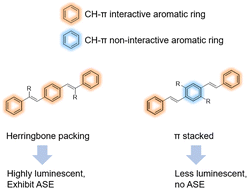
Single-crystals composed of organic π-conjugated molecules with high solid-state luminescence are promising candidates for laser media. Among them, trans,trans-1,4-distyrylbenzene (DSB) derivatives are particularly attractive due to their high photoluminescence and are frequently employed in systems of laser media and amplified spontaneous emissions (ASE). Although numerous DSB derivatives have been designed for single-crystal laser applications, achieving high solid-state luminescence remains challenging because of the difficulty in predicting and controlling aggregation motifs. We report herein a chemical structure design strategy based on fluorination of DSBs to achieve ASE. The fluorination at the central phenylene of DSB effectively inhibited intermolecular CH–π interactions. In contrast, the fluorination at the α- or β-position in the vinylene unit did not suppress such interactions, resulting in CH–π interaction-driven herringbone packing. The fluorinated DSBs exhibiting herringbone packing in the crystal-state demonstrate ASE due to the high luminescence performance based on the small intermolecular overlapping of their π-orbitals.
 Please wait while we load your content...


